A wave of excitement! Several foreign companies are opening new vertical farms
Source: 中国之光网|| Views: 5102
In recent years, many foreign companies have invested heavily in the vertical farming sector. Companies such as Plenty, vGreens, Little Leaf Farms, and Soli Organic are all opening new . Through technological innovation and business model optimization, they are gradually moving vertical farms from the laboratory to the market, attracting increasing attention from capital markets and investors.
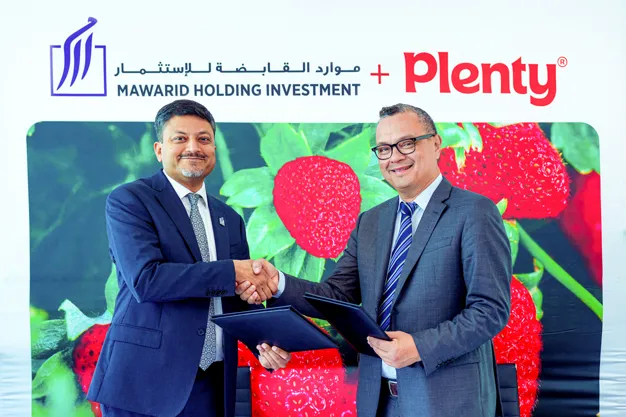
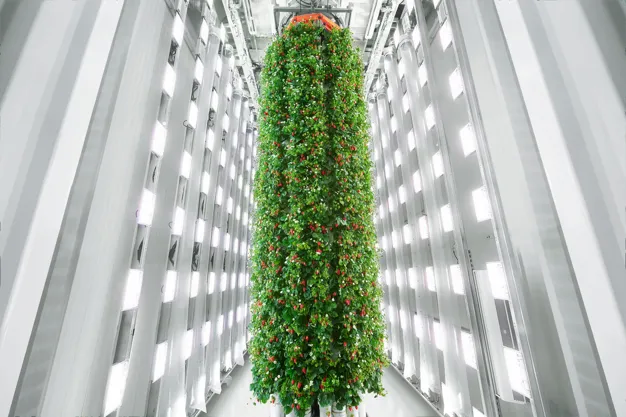
Plenty will build a large-scale strawberry vertical farm in Abu Dhabi
has entered into a multi-year regional exclusive cooperation agreement with Mawarid Holding Investment to introduce locally grown fresh produce to countries in the Gulf Cooperation Council (GCC). Mawarid is a subsidiary of Alpha Dhabi Holding, a large listed company on the Abu Dhabi Securities Exchange (ADX). The joint venture established by Plenty and Mawarid will invest over AED 500 million (USD 130 million) in the first collaborative project within the Gulf Cooperation Council—the Abu Dhabi vertical farm, which is capable of producing more than 2 million kilograms of strawberries annually. The joint venture plans to develop up to five farms over the next five years, which will require investments of up to AED 2.5 billion (USD 680 million).
Kashif Shamsi and Arama Kukutai Following the strawberry farm in Virginia later this year, the new farm will become the world’s first commercial-scale vertical strawberry farm outside North America. The Abu Dhabi farm covers approximately 7,500 square meters (81,000 square feet) and is scheduled for completion by the end of 2026.
vGreens plans to open a new vertical farm in Singapore
It is reported that vGreens will open a new company in Singapore later in 2024. Using AI control software to produce berries in vertical farms. The newly established subsidiary will focus on developing automated using artificial intelligence to efficiently deliver high-quality plant materials globally. Plant materials are crucial for the productivity and profitability of indoor farms. In the long term, Singapore could be a key location for vGreens to enter the entire Asian market. Singapore is increasingly relying on modern methods to promote food production, and vertical farming is seen as one of the most promising solutions. This approach enables self-sufficiency and resilience in food production, which is extremely important for a region heavily dependent on imports. Furthermore, vGreens plans to collaborate with food retailers from 2025 onwards to build the first industrial plants. These plants will enable retailers to provide fresh products year-round, unaffected by traditional supply chains, weather conditions, and seasonal limitations. Additionally, production conditions can be flexibly adjusted according to specific customer and market requirements. Together with industry strategic partners, vGreens provides advanced solutions for supermarkets and retailers.
Little Leaf Farms opens a new greenhouse
US-based Little Leaf Farms is further expanding in McAdoo, Pennsylvania, with a new greenhouse set to open this fall. The new 10-acre greenhouse is Little Leaf Farms' third facility in Pennsylvania.
Little Leaf Farms currently accounts for nearly 50% of packaged salads grown via CEA in the United States, reaching over 53% of the national population, a share that will continue to grow after the new greenhouse opens. The brand plans to open several more greenhouses in the future to continue serving its growing consumer base and remains committed to supplying leafy greens to more stores in the Southeast and Midwest regions. Little Leaf Farms recently completed a new credit facility worth $250 million, including a term loan facility, a delayed draw term loan, and a revolving credit facility.
Soli Organic Launches Advanced Vertical Farm
Indoor agriculture company Soli Organic has taken a major step by launching the most technologically advanced vertical farm to date in the Brooks community of San Antonio. The farm utilizes Soli Organic's unique soil-based growing system, efficiently leveraging automated lighting, precise organic irrigation, vertical and horizontal space, and other production factors to achieve optimal quality and high yields. The farm's facility design reduces water usage by 90% and occupies only 1% of the land used by traditional outdoor agriculture, while avoiding product quality losses caused by weather fluctuations. Its efficient technology maintains low costs and high-quality growth—exactly the value consumers need.
Pinnacle Food develops customized smart planting systems
另一家加拿大智慧农业新技术公司则另辟蹊径,智慧农业服务商PinnacleFood依托其新落成的北美垂直种植大数据中心,积极开展垂直农业、植物工厂技术验证和大数据应用,通过系统性地集成技术、硬件及软件,开发和建设定制化智能种植系统,将人工智能、机器学习与垂直农业技术结合应用,在土地资源、水资源日益紧张的条件下,提出了革命性的不依赖自然环境的可持续物保障方式。 PinnacleFood has been highly recognized by investors and recently successfully completed a Series B financing round worth tens of millions of yuan."In today's economy, consumers want value, which is the original intention behind the design of our new farm in San Antonio," said Matt Ryan, CEO of Soli Organic. "This high-tech farm will provide retailers and consumers with fresh agricultural products, reflecting our commitment to a scalable, sustainable, and profitable model."