
[2012 China Lighting Award Project] Shenzhen OCT Harbour Cultural and Entertainment District Lighting
More Photo Galleries:http://www.alighting.cn/case/2012/7/4/94714_44.htm
This project won theThird Prize in the 2012 China Lighting Award for Engineering Design (Parks, Squares)
As China's most distinctive coastal commercial project, OCT Harbour integrates unique commercial elements such as China's first international waterfront shopping mall, the first high-end dining and entertainment waterfront district, the first large-scale multimedia water show theater, the first high-end commercial cultural and creative exhibition center, the first top-tier urban club, the first five-star standalone flagship cinema, and international-grade office and hotel clusters. It gathers well-known high-end brands from home and abroad, constructing a modern, fashionable, and ecological commercial cultural atmosphere. Major themed festivals such as the OCT Carnival, OCT Dragon Boat Festival, and OCT Harbour (International) Music Festival are held here in rotation, interacting with the world's largest multimedia themed water show—"Deep Blue Mystery," forming OCT Harbour's unique "Three Festivals and One Show" city-level carnival feast, bringing a unique and charming international coastal living experience.
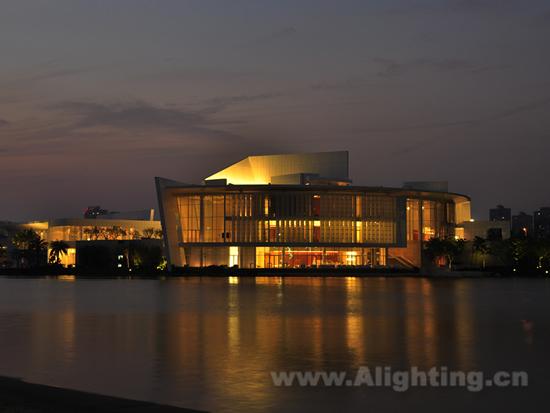
Happy Coast Project Urban Cultural and Entertainment Zone: The buildings include commercial facilities, urban clubs, landscape slopes, and a tourist information center; the total construction area is 96,000 square meters, with a total of 26 individual buildings. The facade lighting project is mainly distributed across Buildings 1-25, with most buildings being 2-3 story villa-style structures. Building 1 is a hotel, with a total building height of 24 meters, partial two-story basement covering an area of approximately 36,000 square meters, and 6 above-ground floors.
The main contents of the Happy Coast Project Urban Cultural and Entertainment Zone are:
1. Procurement, installation, and commissioning of lighting distribution boxes, cabinets, and control cabinets;
2. Procurement and installation of various distribution lines, conduits, cables, and other materials;
3. Procurement and installation of various luminaires (including procurement and installation of fixed brackets and accessories);
Characteristics and Challenges of Construction:
1. Comprehensively plan the construction schedule for the entire project, coordinate effectively with the client and other specialized teams, diligently carry out all reservation and embedding works, and jointly strengthen on-site management and coordination with the client and the supervision unit.
2. As this project is located in the urban area, civilized construction practices such as environmental protection, noise control, and dust control must be implemented to ensure that surrounding areas, daily life, and work are not affected.
3. The project features advanced craftsmanship, high quality requirements, complex construction conditions, and significant technical challenges.
4. The construction area is extensive, light positions are scattered, pipelines are long with many bends, making operation difficult.
5. Installation of luminaires on exterior wall facades: conduit wiring cannot be mechanized and must be done manually, which is unfavorable for ensuring project quality and construction progress.
[NT:PAGE]
1. Detailed lighting technical specifications
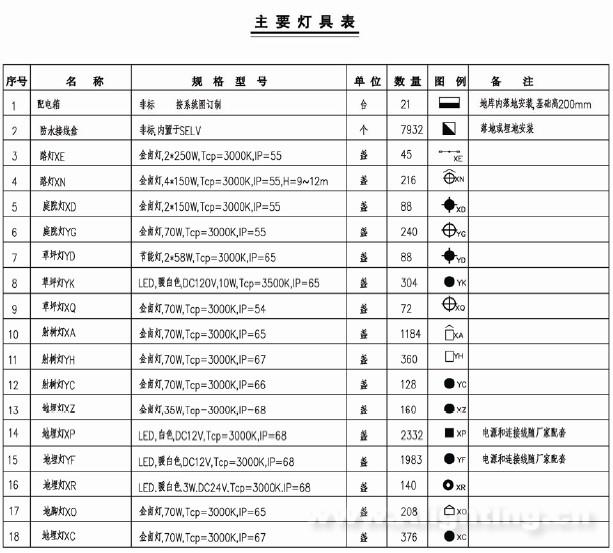
2. Innovations in lighting design concepts, methods, etc.:
Based on the creative proposal and the required illuminance for each area, select light source types and luminaires, and determine the lighting method and layout plan, while prioritizing energy savings.
1) Purpose of daylighting design: To make full use of natural light by designing reasonable window forms, areas, and positions, ensuring sufficient indoor lighting while meeting requirements for the distribution of luminance in terms of light direction.
2) Methods to prevent glare:
1. The "two lows, one high" lighting principle: low illuminance, low color temperature, and high color rendering. This ensures that the extensive lighting system across the entire scenic area remains well-organized, effectively avoiding light fog and glare.
2. Use luminaires with a larger shielding angle.
3. Reasonably arrange luminaire positions and select appropriate hanging heights.
4. Appropriately increase ambient luminance to reduce luminance contrast, especially the luminance contrast between the work object and its directly adjacent background.
5. Use matte materials.
3) Color expression and intensity.
Apart from effect lighting, for other types of lighting that do not use colored light, the role of the illumination is to faithfully reflect the colors of the illuminated objects. Because luminaires with high CRI light sources are used, there is no color deviation, restoring the inherent color of the illuminated objects to the greatest extent.
[NT:PAGE]
3. Energy saving measures in lighting design:
I. Choose cost-effective LED luminaires
Highly energy-saving LED light sources and other energy-efficient lighting sources were adopted, and five stages were designed in the lighting control program: normal stage, transition stage, climax stage, festival stage, and energy saving stage. This controls both the lighting effects and the operating costs. The project features dozens of different lamp types and thousands of various luminaires. In actual operation, it is both energy saving and environmentally friendly, with costs far lower than those of traditional light sources.
II. The effects of using the control system are as follows:
1. Achieve humanized lighting.
2. Improve management level.
3. Save energy.
4. Extend the service life of luminaires.
4. What new technologies, new materials, new equipment, and new processes are used in the design:
I. Smart lighting control system
The system adopts a centralized control and management with decentralized execution approach, configuring a central monitoring center and intelligent control lighting cabinets. The former includes equipment such as control computers and main communication controllers to control and manage the entire system. It communicates control commands to the programmable controllers in each intelligent control cabinet via the network, while receiving information on automatic and manual operating statuses, luminaire on/off statuses, etc., from the programmable controllers within the intelligent control cabinets, and takes handling measures in case of abnormalities. Setting the optimal operating mode for lighting extends the service life of luminaires, thereby reducing maintenance workload and equipment costs. The control circuit is separated from the load circuit, and the control circuit uses low voltage to ensure personal safety.
2. Perform conduit and wiring works properly
The entire project features a large number of luminaires, high electrical load, and numerous distribution circuits, while the construction process must be closely coordinated with the facade engineering work. Much of the conduit and wiring is concealed; to ensure safety, flame-retardant cables are used for distribution wires, installed in steel conduits, with secure and reliable connections between wires and luminaires. To prevent ground faults, circuit breakers with leakage protection functions are additionally installed on the power supply side of the distribution circuits. Meanwhile, there are a large number of weak current control lines in the project, which are effectively isolated from strong current lines during construction to avoid electromagnetic interference affecting control effectiveness. Since LED lamps are non-linear loads, they generate significant harmonic currents during use, which can affect power supply safety and waste substantial electrical energy; therefore, effective harmonic suppression measures are taken on the power supply side.
5. What environmental protection and safety measures are used in lighting design:
1) Set up designated garbage pools or trash bins on-site, clean up site waste at any time, and regularly apply pesticides to eliminate the "four pests".
2) During construction, ensure "work completed, materials cleaned up, site cleared," leaving no debris or hazards at the construction site, and clean up once before getting off work each day.
3) Materials and equipment required for the project shall be stacked neatly and securely on-site, and must not exceed width or height limits as per relevant regulations.
4) Strengthen protection of equipment awaiting installation and already installed equipment on-site to prevent secondary contamination, loss, or damage. Enhance security measures in the construction area.
5) Waste oil, wastewater, and other by-products generated during construction must be treated before discharge.
6) Noise control measures:
A. Adopt low-noise processes and construction methods during construction.
B. If the noise from building construction operations may exceed the noise limits at the construction site, our company will submit an application to the competent construction administrative authorities and the environmental protection department before commencement of work, and construction may proceed only after approval.
C. Reasonably arrange construction sequences to avoid, as far as possible, carrying out noisy building construction operations during midday and nighttime.